Agentic Patterns
and Design System
How a two-week AI vision sprint evolved into the design system now shaping how AWS builds AI experiences at enterprise scale
Background
This is a story about how a two-week design sprint evolved into something much bigger — a design system that's now shaping how AWS builds AI experiences at enterprise scale. It's a story about strategic design thinking: seeing an opportunity and turning it into organizational change.
It's told in three acts: The Vision — a two-week proof of concept to secure leadership buy-in for AI-first workflows. The Catalyst — what that vision unlocked: strategic alignment, roadmap influence, and the realization we needed systematic patterns, not one-off designs. The System — where I am now, contributing to the Phantom Design System, building the components and patterns that make that vision scalable across AWS.
There's no "we increased conversion by 15%" moment here. What there is, is a story about how design can shape organizational strategy.
The landscape
Building enterprise products takes as much time as identifying the most important problem to solve and why — due to the complex interweaving of AWS's systems and infrastructure. The reality: product teams are getting leaner, with many products (and even teams) lacking dedicated UX. That means user experience is becoming fragmented — customers get totally different experiences depending on which team built what.
The opportunity
Three things were converging: Asset Financial Services (AFS) was building a new "Metrics Library" feature. Uno, AWS's unifying platform, was bringing all products together — with AFS intending to migrate to it by year end. And Jarvis, Amazon's AI assistant, was enabling agentic workflows, where AI doesn't just respond, it acts.
With an upcoming leadership visit to my Jersey City hub, I got the stamp of approval from my director — and two weeks to prove it.
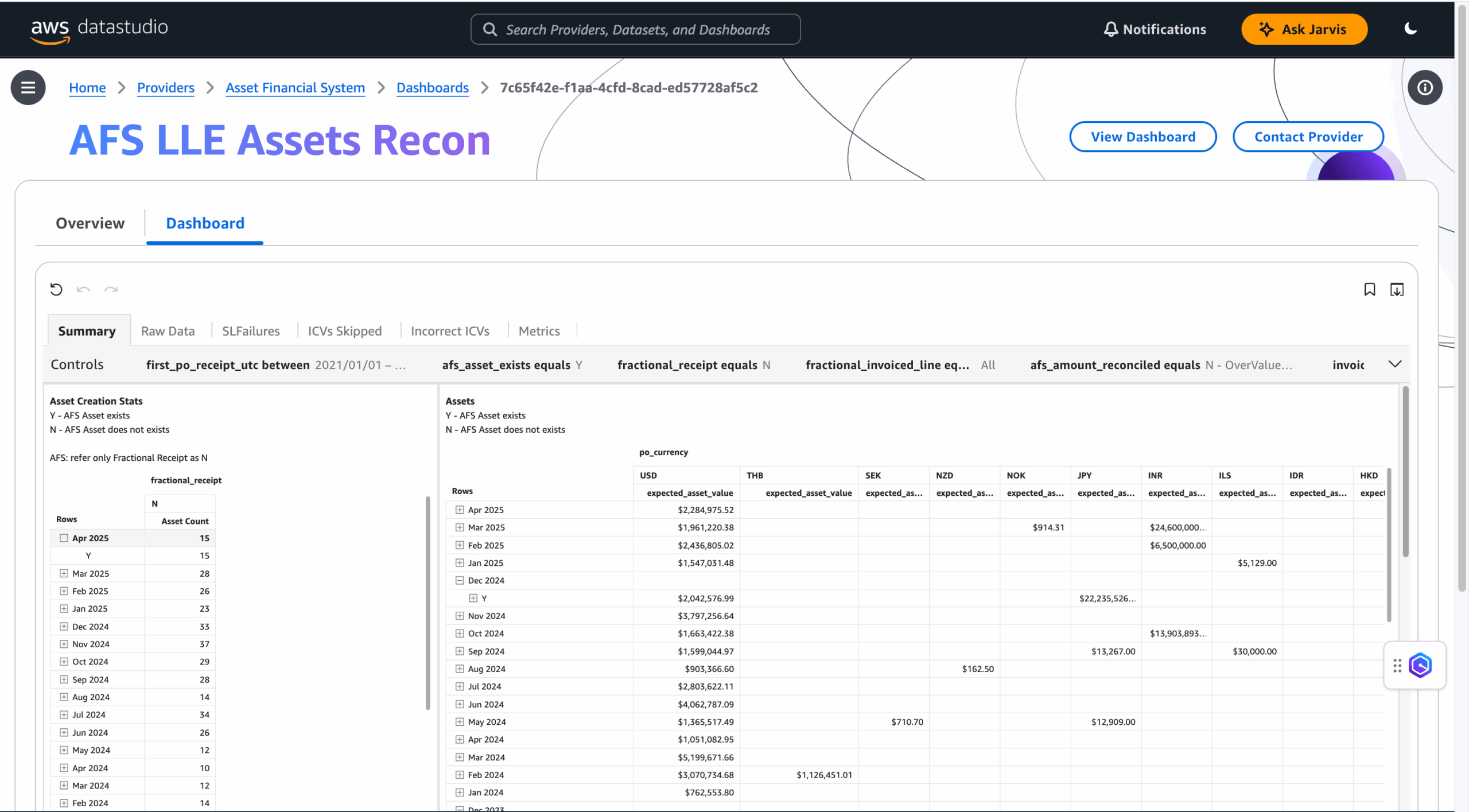
AFS previously sat as a dashboard within another product
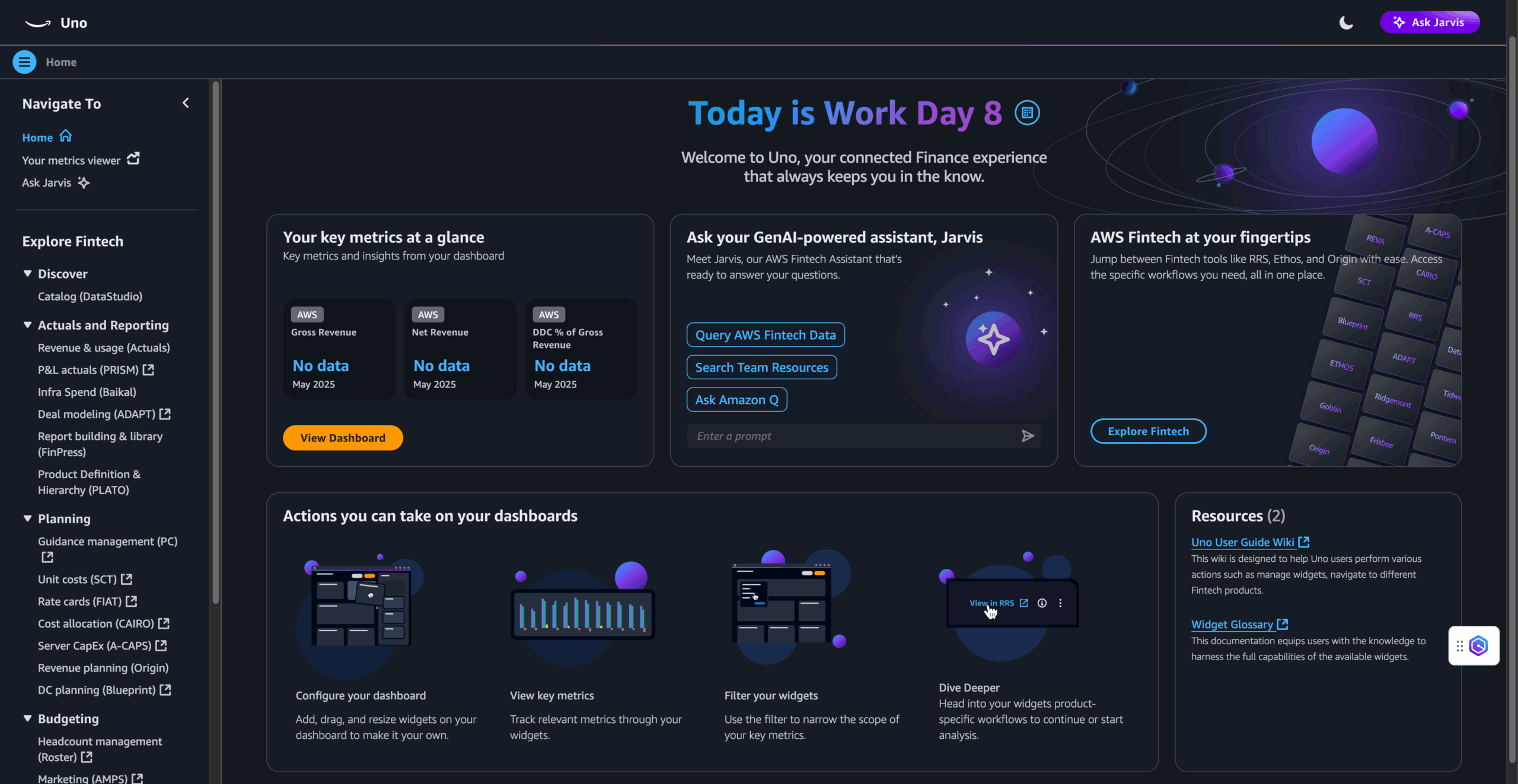
Uno unifies different products into a personalized dashboard view
Meet James
You start with the user. James is an Infrastructure Finance Manager, and here's what he told us:
That's not a small ask — it meant understanding what was spent, why, whether it translated into revenue, and explaining all of it to leadership in a way that drives decisions. Mapping that entire journey, from data collection to executive reporting, became our north star.
The prototype
In an 8-session, 2-week design sprint — cross-functional whiteboarding, system audits of AFS and Uno, persona-driven workflow mapping, and a high-fidelity prototype — I built a comprehensive AI-first experience showing James getting real-time visibility into spending through an intelligent dashboard, Jarvis auto-generating reports with the metrics that matter, a conversational interface for plain-language questions, and seamless executive reporting connecting spend to revenue.
The point wasn't to build all of it immediately — it was to show leadership the future state and get them to say, "Yes, we need to go there."
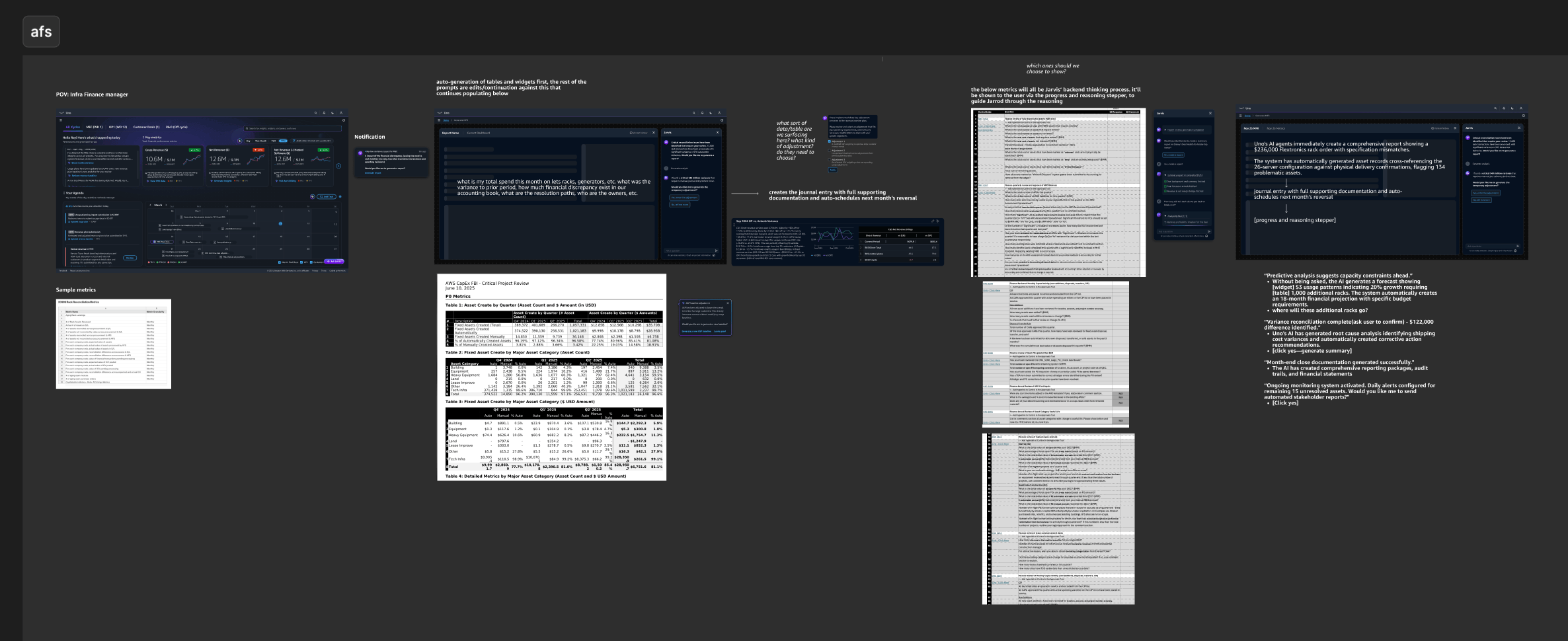
Collaborative whiteboard sessions to flesh out ideas
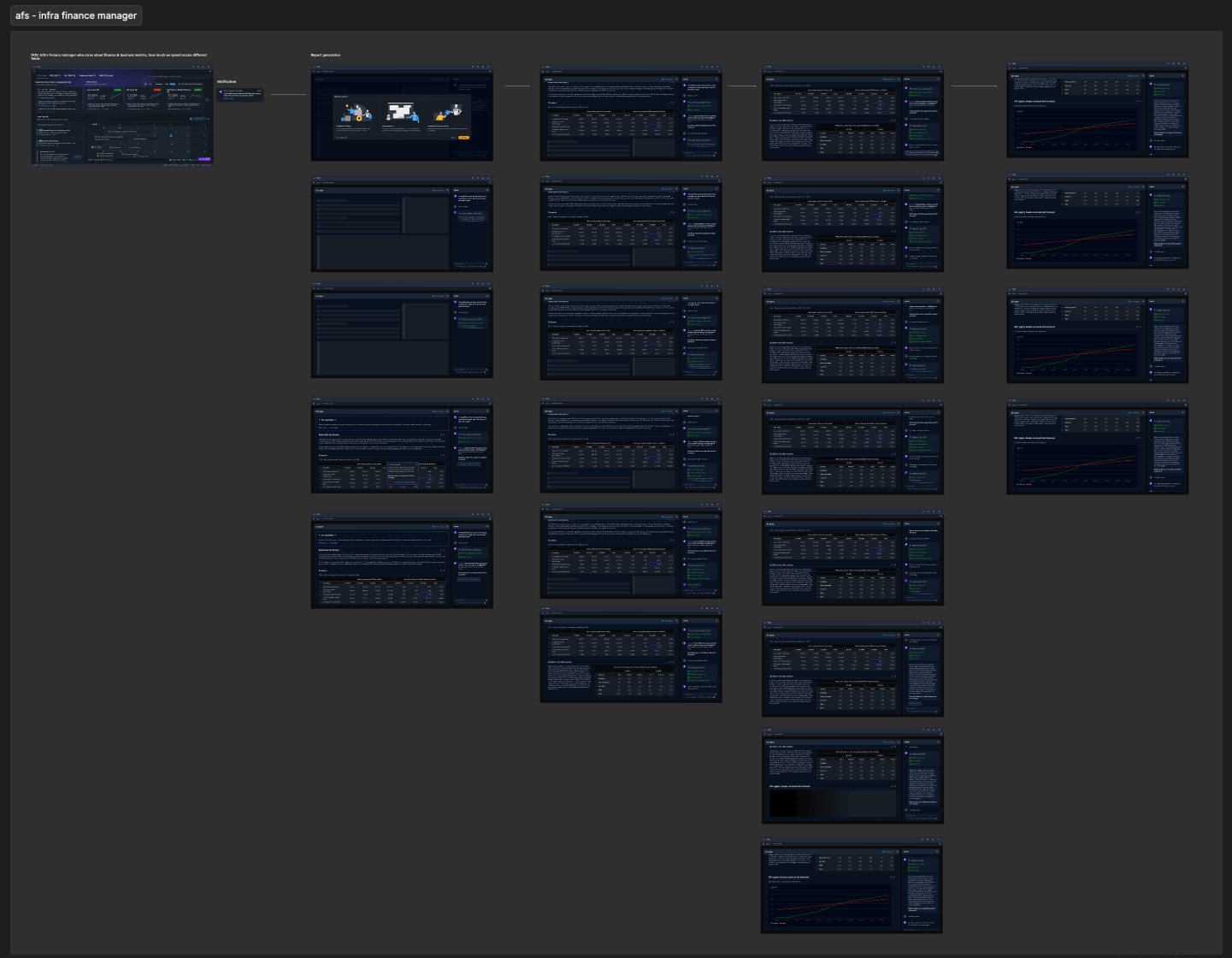
Final designs showcased relevant data and context
Strategic impact
The north star vision worked:
- Buy-in: Secured enthusiastic buy-in from AWS Fintech leadership for AI-first workflows.
- Influence: Directly shaped the 2026 AI-integration rolling roadmap strategy.
- Establishment: The patterns from this prototype are now informing broader AWS-wide AI integration efforts.
- Catalyst: Raised the question that led to a design system — "How do we actually build this at scale?"
Why now
The timing converged from several directions: front-end tooling was maturing fast (Next.js, Tailwind, Figma integrating with dev workflows, AI-based "vibe coding" becoming real), the industry was shifting toward agentic workflows, and AWS was at exactly the right moment in its AI adoption journey for leadership to invest in doing this properly. There was also no precedent yet for agentic UI patterns at enterprise scale — which meant an opportunity to define one.
Phantom delivers outsized returns
Phantom — the platform this work fed into — is the easiest way to deliver consistent, enterprise AI experiences at Amazon scale: it speeds up delivery, reduces cognitive load, and accelerates AI adoption. At the time, it was built by a single engineer, needing an estimated 24 engineering-weeks to launch its enterprise MVP.
With positive traction across teams, confirmed buy-in from different orgs across Amazon, and growing partnerships, the team pitched Phantom to leadership at annual operational planning — the multiplier effect design systems create: turning individual effort into organizational leverage.
Introducing Phantom Experience Builder
We brand Phantom as more of an experience builder than a design system — "design system" implies limitations, and we're not just designing components, we're defining interactions and shaping the path forward. Phantom standardizes and accelerates application development across Amazon through unified workflow patterns and an AI-powered application builder.
My role: contributing to the Phantom Design System — specifically establishing reusable, accessible AI patterns that any team at AWS can use. The vision raised the question; the system is the answer.
The scale
Our focus: patterns that enable both speed and enterprise-grade quality. We're not designing for one product — we're designing for scale.
System architecture
Built on Brad Frost's Atomic Design principles:
My focus area is the AI and conversational patterns layer: chatbot interactions, agent transcript behaviors, and how these AI components integrate with canvas interactions — patterns no one has really solved at enterprise scale yet.
Components I've designed
Backgrounds
Gradient backgrounds at different alpha opacities for button hovers and active states — safe primitives that can be forked and referenced without breaking anything built on top.
Loading shimmer
A skeleton placeholder over sections where content will appear, giving users a sense of what's coming while data is fetched.
AI-filled values
AI-generated content, visually highlighted for transparency — with a change-preview state showing before/after values so users stay in control of edits.
Auto-fill
Intelligent, AI-powered form completion based on user history and contextual data, built to streamline bulk data entry.
Action stripe
A container that surfaces AI-powered actions and suggestions with clear visual hierarchy and contextual relevance.
Chatbot panel
The base of most Phantom AI experiences — the foundation the canvas interactions below are built on.
Chatbot + canvas interaction
The core challenge: when a user interacts with the chatbot, how do we show AI actions on canvas? Users can prompt AI via an open input or the chatbot panel, and AI kicks off a workflow in response.
Full page generation
The canvas shows a loading shimmer while AI builds the content, with the chatbot panel docked to the side — used when a request calls for an entirely new page, like a full report.
Single field or element generation
For smaller edits, users ask AI to change or update a specific piece of content in a specific container, without regenerating the whole page.
Documentation & governance
Designing the component is only half the work. Every pattern ships with documentation standards — when to use it, do's and don'ts, WCAG accessibility compliance, and implementation notes for developers — plus a contribution process: designers propose new patterns, the team runs review and refinement sessions, patterns get integrated into the master library, and updates distribute to all teams through release notes. Tooling: Figma for design components, with branching and version control to keep it organized.
Results, impacts, metrics
Multiple product teams using Phantom patterns; library usage growing quarter over quarter.
Enabled enterprise AI experiences at Amazon scale; reduced the time for teams to build AI features.
Established an AWS standard for agentic AI patterns, informing the 2026 roadmap.
A team of designers now builds on these foundations through a collaborative contribution model.
Personal takeaways
Systems thinking at scale
- Designing one component impacts dozens of products.
- Documentation is as important as the design.
- Accessibility must be built in, not bolted on.
AI patterns are unique
- Conversational UI requires new mental models.
- Users need transparency into AI actions.
- Progress indication is critical for trust.
Strategic design matters
- Vision work opens doors for systematic execution.
- Early patterns influence long-term direction.
- Design systems enable organizational velocity.
What's next: expanding the AI component library, deeper integration with development workflows, and scaling these patterns across more AWS products.